What Is HYPE Used For? Key Utilities of the Hyperliquid Token
Hyperliquid's HYPE token is far more than a ticker to trade. As the native asset of one of the fastest-growing on-chain derivatives networks, HYPE is woven into nearly every layer of the protocol — from paying network fees and securing the blockchain to unlocking trading discounts and governing the protocol's future. If you have ever wondered what actually gives HYPE its utility beyond speculation, this guide breaks down every core function.
Quick Background: What Is HYPE?
HYPE is the native token of Hyperliquid, a custom Layer-1 blockchain purpose-built for high-performance perpetual swaps and financial applications. It launched in November 2024 with a fixed maximum supply of 1 billion tokens — a hard cap that cannot be changed. The distribution was heavily community-weighted: 31% went to a genesis airdrop for over 94,000 early users, roughly 38.9% is reserved for future emissions and community rewards, 6% funds the Hyper Foundation, and 0.3% supports community grants. Core contributors received 23.8% under a one-year cliff with linear vesting through 2028. Notably, Hyperliquid raised no venture capital, making the community-facing allocation — over 76% of total supply — one of the highest among major token launches.
Now, let's look at what HYPE actually does.
1. Paying Network Gas on HyperEVM
The most fundamental utility of HYPE is also the simplest: it is the gas token of the Hyperliquid network. Every transaction executed on HyperEVM — whether a perpetual trade, a token transfer, a smart contract interaction, or a DeFi operation — requires HYPE to pay network fees. This creates consistent, organic demand for the token from anyone using the network, rather than relying solely on speculative trading. As HyperEVM attracts more deployed protocols and users, gas-driven demand for HYPE scales directly with network activity.
2. Protocol Governance Through HIPs
HYPE holders have a direct say in how the Hyperliquid protocol evolves. Governance operates through Hyperliquid Improvement Proposals (HIPs), and voting weight is determined by the amount of HYPE a user stakes. Proposals can cover fee parameter changes, reward distribution rules, protocol upgrades, treasury allocations, and ecosystem funding decisions. Governance has already produced consequential outcomes: in December 2025, the community voted to permanently burn over 37 million HYPE from the Assistance Fund, demonstrating that token holders hold real decision-making power rather than symbolic influence.
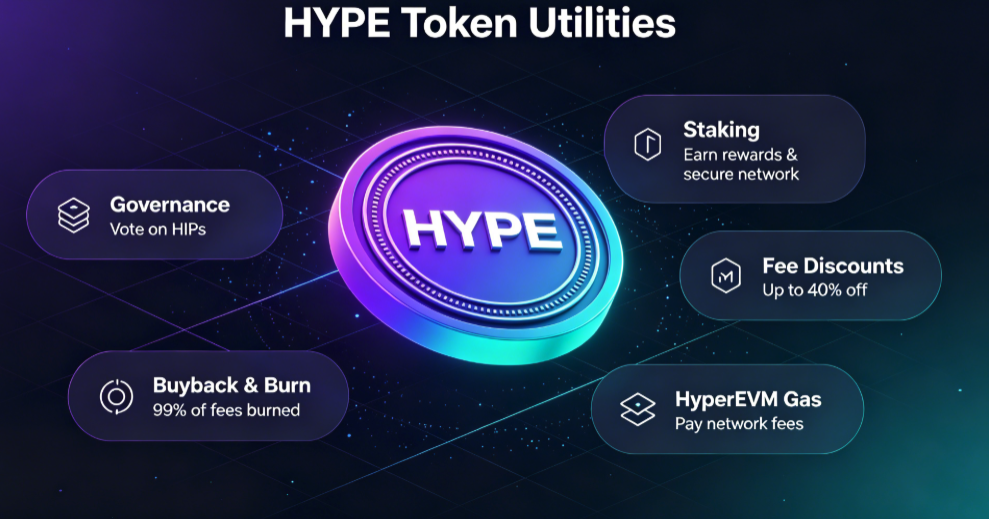
The infographic below summarizes the six core utilities of HYPE at a glance.
3. Staking: Earn Rewards While Securing the Network
Staking HYPE serves a dual purpose: it generates passive yield for holders and underpins the security of the Hyperliquid Layer-1. Users who stake HYPE can delegate their tokens to validators, who run network nodes, process transactions, and maintain blockchain consensus. In return, stakers earn a share of protocol rewards. As of recent data, roughly 400 million HYPE is staked across the network, with annualized staking yields around 2.37%. The mechanism also includes slashing rules that penalize malicious validator behavior, ensuring staked capital aligns with honest network operation. For users who do not want to run their own validator, delegation provides a low-friction way to earn yield while contributing to network security.
4. Tiered Trading Fee Discounts
One of the most tangible utilities for active traders is the tiered fee discount system. The amount of HYPE a user stakes determines their discount level on perpetual trading fees, with six tiers ranging from 5% to 40% off:
Tier HYPE Staked Trading Fee Discount
Wood 10+ 5%
Bronze 100+ 10%
Silver 1,000+ 15%
Gold 10,000+ 20%
Platinum 100,000+ 30%
Diamond 500,000+ 40%
These discounts apply to both maker and taker fees and can stack with other platform promotions. For high-volume traders, the savings can be substantial, creating a strong incentive to hold and stake HYPE rather than keeping it on an exchange. The tiered structure also means that even smaller holders can benefit — staking just 10 HYPE unlocks the first discount level.
5. DeFi Collateral and Ecosystem Utility
HYPE extends beyond the core exchange into the broader Hyperliquid DeFi ecosystem. The token can be used as collateral across various decentralized applications built on HyperEVM. A notable example is the HYPE Asset Use Service (HAUS) agreement with Felix, one of the earliest HyperEVM protocols, which enables staked HYPE to unlock additional on-chain utility. As more DeFi protocols launch on HyperEVM — including lending markets, liquidity pools, and structured products — HYPE's role as collateral and ecosystem asset is expected to expand, deepening its integration across the network's financial stack.
6. Buyback-and-Burn: A Deflationary Mechanism
Perhaps the most unique utility of HYPE is its automated buyback-and-burn mechanism. The protocol allocates approximately 99% of daily trading fees generated